By OMNI ADRD
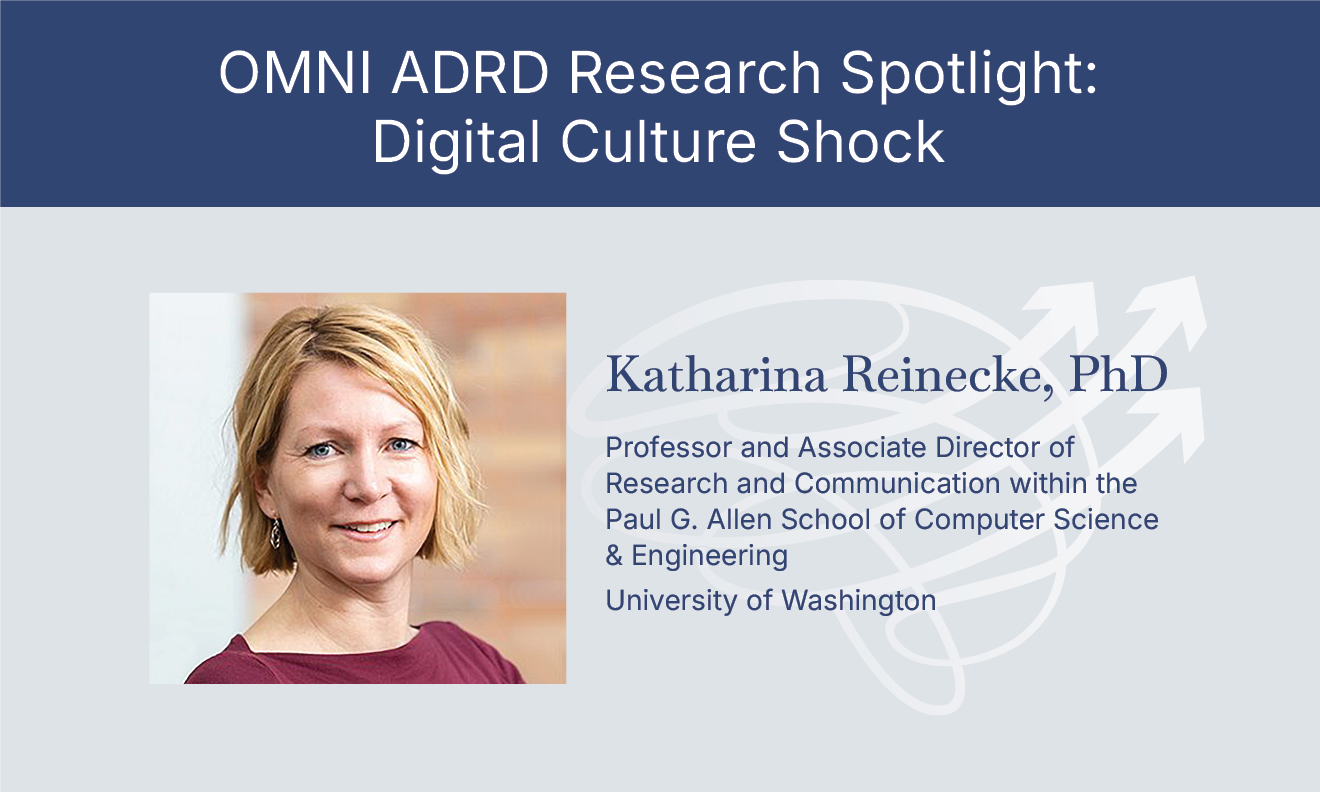
This week, we’re highlighting Dr. Katharina Reinecke’s work on digital culture shock— the experience and impact of actively or passively using digital technology that does not align with one’s cultural practices and norms. Dr. Reinecke, a Professor at the University of Washington and Associate Director of Research and Communication within the Paul G. Allen School of Computer Science & Engineering, has shown that digital culture shock is a ubiquitous phenomenon with implications for how we measure cognition.
In the same way we can experience culture shock when adjusting to an unfamiliar environment, research suggests that contemporary technology can produce digital culture shock. Even changing operating systems (e.g., Apple’s macOS or Microsoft Windows) can frustrate individuals who grew up using one kind of software. When technologies travel across different countries, the shocks can be stronger. Digital culture shock affects well-being through a series of predictable stages: an initial honeymoon phase, an anxiety stage, a rejection stage, and then an adjustment (or acculturation) phase. Like culture shock, digital culture shock can lead to stress and anxiety, but also can ultimately lead to positive outcomes, such as greater openness and adaptability to new environments.
Sources of Digital Culture Shock
Many technologies are designed and tested for individuals who live in societies with democratic, Western, and high socioeconomic features—and who represent a tiny fraction of the world’s populations and cultures. As a result, these technologies can cause digital culture shock for most of the world’s population. For example, users from individualistic, Western cultures tend to engage more in forums that display comments by user rating (e.g., Reddit or Stack Exchange) compared to users from collectivist backgrounds. The latter perceive this approach as a form of self-promotion and prefer an approach that allows for more interaction and trust building.
Research has also found that users from different countries may process information in different ways. For example, a study of Western and East Asian website users found that Westerners tend to scan websites from top to bottom, whereas East Asians tend to scan from the center outward.
User interaction is heavily influenced by the user’s core values. Dr. Reinecke and colleagues found that individuals are more interested in engaging with tools like AI chatbots when they align with the individual’s value system. A survey of 58 countries found that national value systems tend to differ across two dimensions—(a) tradition versus secularity, and (b) survival versus self-expression—yet most AI chatbots are trained to consistently favor self-expression and remain neutral on tradition versus secularity. Most technologies are similarly designed for a narrow group of users, creating several opportunities for digital culture shock.
Implications for Cognitive Research
Over time, accumulating digital culture shocks can incur a cognitive tax, which can result in fatigue and cognitive impairment. This could be particularly problematic for measuring user engagement and performance on measures of cognitive decline, because older users tend to have stronger cultural preferences than younger users.
Given these potential impacts, researchers studying cognition should consider the potential impacts of digital culture shock. Digital culture shock could slow reaction times or might affect the interpretation of practice effects on cognitive tests—which could both reflect learning or habituation to stressful stimuli.
Current research efforts are still exploring strategies to mitigate digital culture shock, and understanding and adapting measures of cognition to different cultural backgrounds will be a critical part of the OMNI ADRD teams’ work.
Want to learn more about our work on assessing brain health for ADRD prevention research? Follow our LinkedIn page or sign up for the OMNI ADRD listserv!
#ADRD #BrainHealth #DigitalHealthTechnology #CognitiveDecline #PreventionResearch