By OMNI ADRD
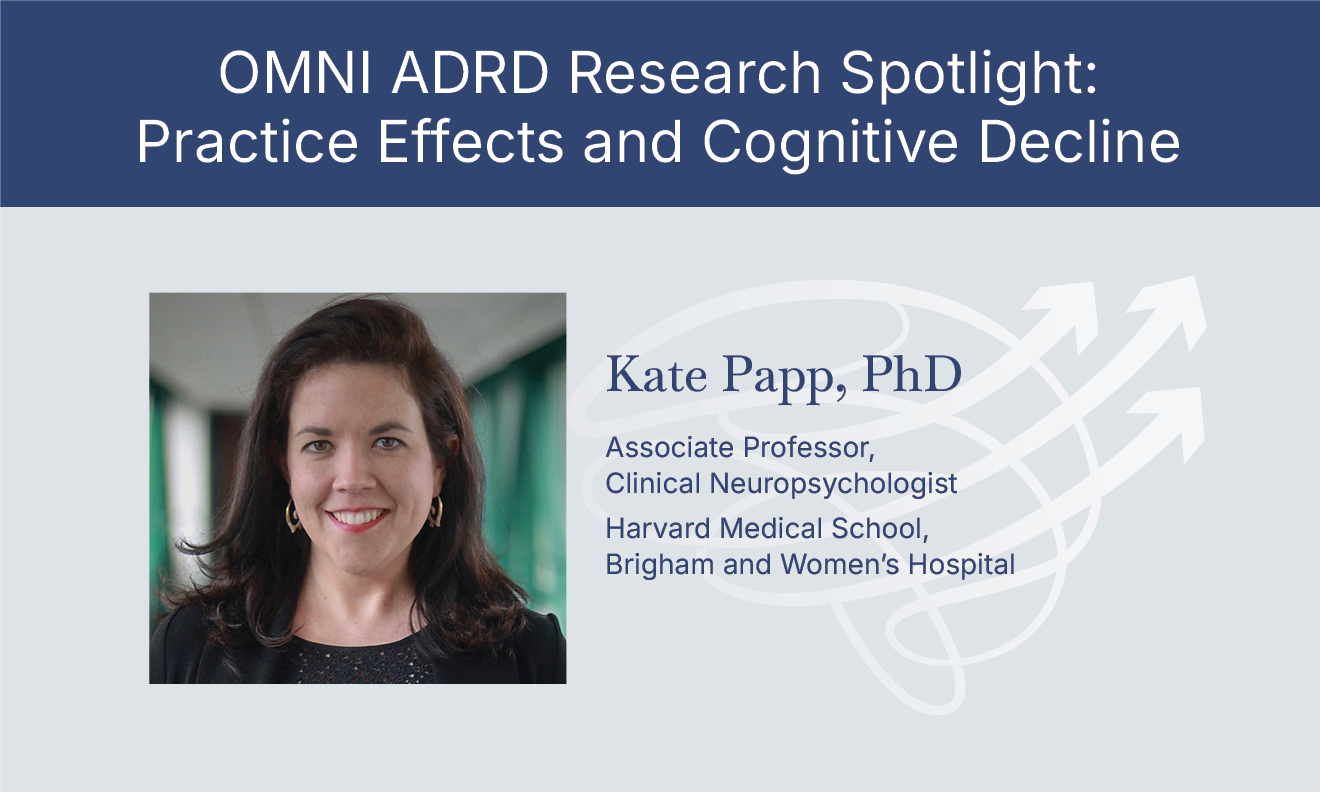
We’re excited to share some research highlights from Dr. Kate Papp, an Associate Professor of Neurology at Harvard Medical School, clinical neuropsychologist at Brigham and Women’s Hospital and Massachusetts General Hospital, and one of our OMNI ADRD network investigators. Her work explores how online tools can help us detect early changes in cognition that indicate an elevated risk for dementia.
Practice Effects in Cognitive Testing
When people take the same cognitive tests over time, their performance tends to improve due to practice effects. Several recent studies have shown that individuals with mild cognitive impairment (MCI) or Alzheimer’s disease (AD) exhibit reduced practice effects when completing the same cognitive assessments over time, and that these reduced practice effects correlate with established AD risk factors and subsequent cognitive decline.
Associations Between AD/ADRD and Reduced Practice Effects
Dr. Papp and colleagues have shown that elevated levels of amyloid-beta—a protein involved in the development of AD—are associated with reduced practice effects. In a subsequent study, Dr. Papp and colleagues used the Boston Remote Assessment for Neurocognitive Health (BRANCH) platform to test participants over several days using the same daily cognitive tasks—a testing protocol known as the Multi-Day Learning Curve (MDLC) paradigm. Participants with elevated levels of amyloid-beta and tau in the brain—two key proteins involved in the development of AD—performed worse on tests over time than other participants, even when they were otherwise clinically unimpaired. In addition, performance was moderately correlated with in-clinic test scores for preclinical AD. In fact, the MDLC may be even more sensitive to early cognitive change than standard in-clinic measures: Dr. Papp’s team found that the MDLC was more strongly associated with brain levels of AD biomarkers like phosphorylated tau-217 than standard in-clinic measures.
Together, these findings suggest that exhibiting reduced practice effects may reflect early failures in memory consolidation and predict risk for AD, even in the context of otherwise normal performance on cognitive tests.
Future Work
Dr. Papp is now studying whether changes in BRANCH testing performance can predict treatment responses to interventions to improve brain health. Find out more about her work here.
Want to learn more about our work on assessing brain health for ADRD prevention research? Follow our LinkedIn page or sign up for the OMNI ADRD listserv!
#ADRD #BrainHealth #DigitalHealthTechnology #CognitiveDecline #PreventionResearch